Ravi Verma
Ravi Verma
Ravi Verma
Raja Ravi Varma (1848-1906) was born in Kilimanoor, Kerala, and is widely regarded as one of the most influential artists of 19th-century India. Largely self-taught, he gained recognition for combining European academic realism with themes drawn from Indian mythology and literature.
His paintings are known for their naturalistic treatment of the human figure, detailed compositions, and dramatic use of colour and narrative. Through his depictions of figures from epics such as the Mahabharata and Ramayana, he helped shape a popular visual imagination of these stories.
Ravi Varma also played a crucial role in making art more accessible through the establishment of a printing press that produced oleographs of his works, allowing them to reach a wider public. He remains a foundational figure in the history of Indian art.
Raja Ravi Varma (1848-1906) was born in Kilimanoor, Kerala, and is widely regarded as one of the most influential artists of 19th-century India. Largely self-taught, he gained recognition for combining European academic realism with themes drawn from Indian mythology and literature.
His paintings are known for their naturalistic treatment of the human figure, detailed compositions, and dramatic use of colour and narrative. Through his depictions of figures from epics such as the Mahabharata and Ramayana, he helped shape a popular visual imagination of these stories.
Ravi Varma also played a crucial role in making art more accessible through the establishment of a printing press that produced oleographs of his works, allowing them to reach a wider public. He remains a foundational figure in the history of Indian art.

Ravi Verma
The Birth of Shakuntala
/Shakuntala Janam, 1894
Oleograph on paper
34.5 x 21.7 in.

Ravi Verma
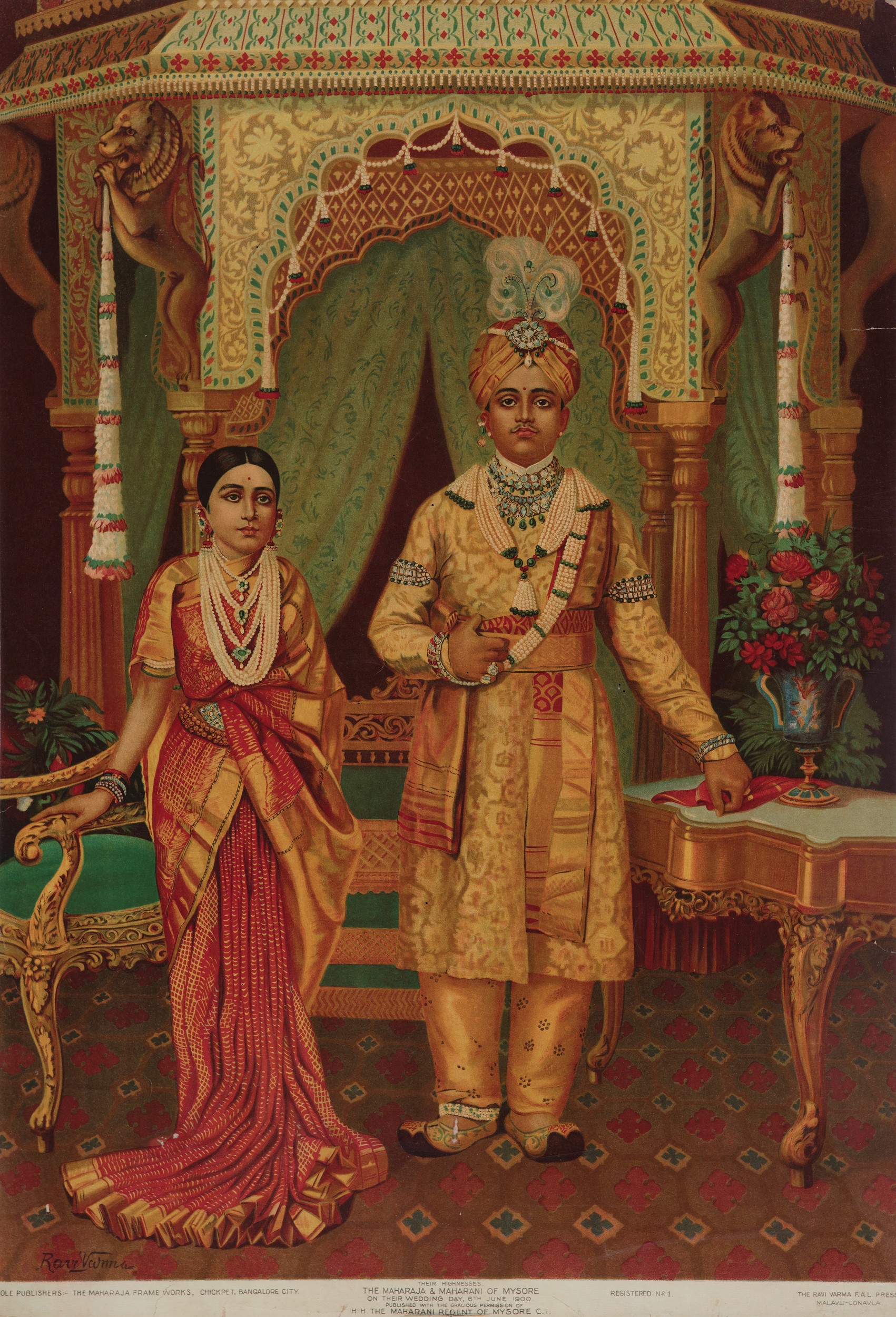
The Maharaja & Maharani
of Mysore, 1930
Oleograph on paper
28.5 x 19.2 in.

Ravi Verma
Mohini
Oleograph on paper
28.5 x 20.2 in.